
Issue A024 of 30 December 2002
New 6th c. BCE Gold Found in Pella
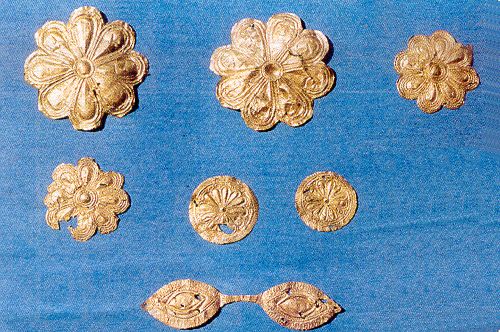 The Greek archaeologists Anastasia and Pavlos Chrysostomou have been excavating ancient graves at Archontikon in the area of Pella, Macedonia, Greece since 1998. The necropolis (cemetery) had been in continuous use from the Iron Age (c1000 BCE) to the early Hellenistic (c280 BCE). However, last summer (2002) the Greek archaeologists focused on graves of Macedonians dating to the mid 6th c. BCE. The discoveries have been astonishing: the plain box like graves revealed a great number of silver and gold items.
The yet unnamed ancient settlement at Archontikon appears to be the most important center in north Bottiaia (could be though as north ancient Macedonia) until the end of the 5th c. BCE when Pella was chosen to become the new capital of the Macedonians. Between 575 and 450 BCE the inhabitants buried their dead in small wooden boxes that they placed in holes in the ground. Men were placed with their heads pointing to the west or the north and women with their heads pointing to the east or the south. Warriors were buried in full armor: helmet, sword, knives, and pikes. Their mouths were sealed with covers made of silver or gold, they wore rings made of bone, silver, or gold as well as gold pins. Also, their cuirasses and whatever other items they wore were decorated with gold bands. Similar gold items such as bands, rosettes, silver or gold earrings, gold rings and necklaces were found in the women's graves. The dead were accompanied with clay male or female figurines, clay animals and birds, clay and bronze vases as well as models of furniture and carts.
The discoveries show that the mid 6th c. BCE burial customs in Archontikon are similar to Mycenaean and Geometric time customs in south Greece. This can be explained by the fact that kingship and accompanying customs were preserved in Macedonia much longer than similar political and social practices in south Greece.
Baktra Found, the Lost Town of Alexander in Afganistan
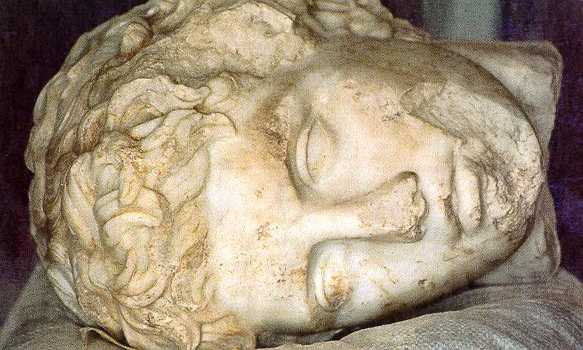 Baktra was founded in c2500 BCE on the south bank of the modern river Amu-Darya or the river Oxos of Alexander's times. Alexander the Great conquered the town in 329 BCE and chose it to be the place of the wedding ceremony when he married Roxane. After Alexander's death, Baktra became the center of a Greco-Baktrian empire until 1220 CE when the hordes of Genghis khan burned the town and massacred the inhabitants. Since the 14th c. the town has been replaced by the modern village of Balh, located west of the modern city of Mazar-e sarif, on the northern border of Afganistan.
French archaeologists excavated in the area in the 1920s and in the 1950s and claimed that Alexander's Baktra was nothing but a myth. However, excavations were repeated in 2002 and finally on June 1st the French team announced the discovery of the walls of Baktra. The first ruins that came to light were buried in the soft soil of the area and were actually discovered by a local when he tried to open a ditch in his yard. In a matter of weeks the archaeologists unearthed paleoislamic foundations of buildings based on Hellenistic ruins. Later, an abundance of findings proved the existence of an important Hellenistic center that must be Baktra.
Did Pythia breathe Ethylene and Recite her Prophecies?
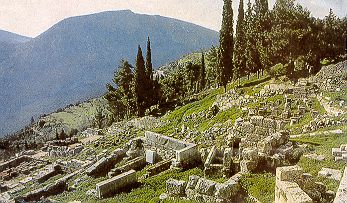 According to investigations by a team of American scientists, Pythia breathed ethylene and recited her prophecies at the Delphic oracle. A geologist, an archaeologist, a chemist, and a toxicologist have come to the conclusion that ethylene, which was released from the ground at Delphi caused Pythia's hallucinations and prophecies. The scientists combine written sources such as Ploutarch with geological analyses and the effects of ethylene on humans in order to base their theory.
 Back to Cover