
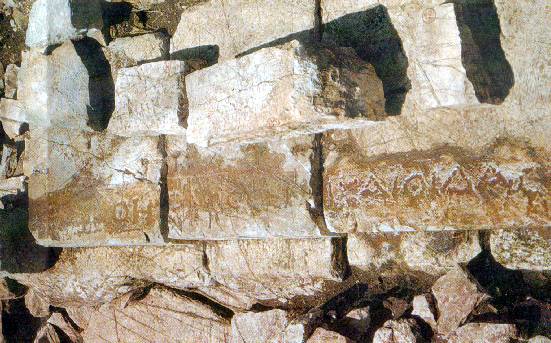
 The shrine of Eileithyia in Messini, the Peloponnese, sheds new light on homosexual and religious practices in ancient and modern world. Excavators under the supervision of Prof Petros Themelis unearthed a 1,95 m. long inscription from the base of a temple, which was dated to the 2nd-3rd century AD. The inscription reads "Therylos enik' Aithida" (Therylos had a relation with Aithida) proving the intercourse of the two men. Prof. Themelis explains that "homosexual activities in shrines, public places and religious festivities were not a rare practice […] especially in the Cyclades, e.g. Thera of the archaic period. This is not the case though from the Hellenistic age onwards."
Excavations all over Messini, according to Prof Themelis, have proven that worship of dark chthonic forces, as that of the Eileithyia temple on mountain Ithomi, was maintained and performed in the area. Prof. Themelis suggests that "these practices were testing young trainees by initiating their belief to dark deities". As the unique inscription at Eileithyia showed, paganism and worship of dark deities continued to prove devotion to God during the early Christian period. Such activities performed in a Christian temple, although by definition self-contradictory, prove the strength of tradition and the power of religion.
‘Neighborhood E’ at Marousi, as the newly constructed Olympics 2004 journalists' village is called, has been planned on and around settlements going back to the 3rd and between the 9th and 11th century AD. Two blocks of buildings of late Roman and mid Byzantine period will be preserved to testify that the area was affluent, vibrant and largely agricultural. Part of the findings at the excavations that is, jars, pots, ovens, pans, kettle, and inscriptions will be transferred to the Byzantine Museum in downtown Athens. Remnants of houses, store rooms, cisterns, buildings of subsidiary use and part of the walls and fences will be maintained to remind today’s guests of their older hosts.
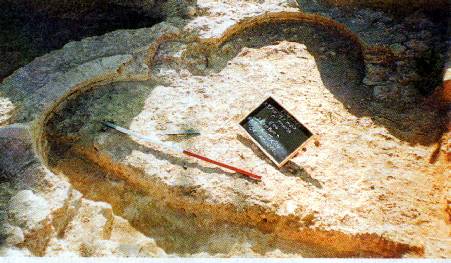 According to the archaeologists of the 2nd Ephorate of Greek Antiquities who worked under the supervision of Dimitris Skilardis, settlements were already developed by the 3rd century AD. A mid Byzantine period clay inscription on a wall of a house confirms the boundaries of the house it belonged to and its previous occupants. A particularly interesting building has been excavated by the team of archeologists at the area where the journalist village has been built. Excavation of building E4 has brought to light historically and archeologically important remnants of constructions at a depth of just 30-40 cm.
Archeologists who have excavated the area have drawn the conclusion that the whole of the newly constructed 2004 Olympics journalists' village has been built upon an old agricultural and highly developed settlement. Among the mobile findings, there were 13 bronze coins that verify the life span of the settlement as three of them date to the 3rd century and the rest between 1075 and 1079 AD.
Although the excavations have already lasted for a year, there is much more to be uncovered and excavated. What remains equally important to the construction of the village itself however is that it serves as a link between the past and the present, the present and the future. That’s the main message of the Olympics as well as the beauty of peace and continuity.


