 |

THE SETTLEMENT OF THE REFUGEES IN GREECE (1920 -1930)
When the front of the Greco-Turkish conflict collapsed in 1922 in Turkey and the Greek army was forced to retreat, the new Greek government announced that the persons responsible were members of the previous cabinet and high rank officers who had participated in the expedition. The trial of the six Greek Generals and Politicians began and some of them were found guilty and executed. The crucial historical question is whether they were the only factor of the Greek defeat. Modern historical research can prove that the Great Powers of the period played a significant role in the whole affair and contributed to the Greek failure in Asia Minor.
England and Prime minister Lloyd George were disappointed when Eleftherios Venizelos lost the November 1920 elections and King Constantine, who supported the Germans, came back. The British feared that the disintegration of the Ottoman Empire and the German orientation of Greece would endanger their trade routes through Anatolia to India. The British were ready to support anybody who would prevent the intervention of other powers in the area without publicizing this policy to avoid an open confrontation with their allies. Thus, by distrusting the Greeks and the Greek foreign policy , they allowed Mustafa Kemal of Turkey to organize the resistance.
The French had been the dominant power in the East until the end of the Napoleonic wars in 1815 when they were replaced by the British. The French foreign policy, therefore, waited for an opportunity to take over in the East and was thrilled by the defeat of Venizelos in 1920. Little by little they approached Kemal and signed a commercial treaty in 1921. The return of King Constantine, the rise of Kemal and the Anglo-French rivalry contributed to the abandonment of the Greeks.
The President of the United States, Woodrow Wilson, had already stated in his Founeen Points that he was in favor of the integrity of the Ottoman Empire and free navigation through the Straits of Bosporus. After his defeat in the American elections of 1920 the U.S. returned to the policy of Isolationism according to which the Americans would not be involved in European affairs and vice versa. The Ámericans refused to recognize King Constantine and the Gounaris cabinet but insisted on the settlement of the World War É Greek debt. They followed a policy of neutrality in the Greco- Turkish affair and refused to grant new loans to the Greeks after 1920.
The Italians had participated in World War É expecting to get pan of the Ottoman Empire. When they were not satisfied they landed troops in Asia Minor and marched on Smyrna. The Allies used the Greeks as counter balance and urged them to occupy the area of Smyrna in 1919. At the .end the Italians received the Dodecanese Islands also claimed by the Greeks.
Last but not least the Soviet regime in Russia was disatisfied with the Treaty of Sevres that allowed free navigation through the Straits and endangered Russian safety from the South, since the Black Sea would become an international lake instead of a Russian one. Lenin saw in Kemal the good friend who would support Soviet policy in the area and the Turks were supplied with gold and arms in the hope that Kemal's future government would be at least a russophile one.
Thus, the anti-Greek policy of the Great Powers, which was a result of the rivalry of the powers in the area, along with the delay of the Treaty of Sevres, which gave the time to Kemal to get organized, and the inability of the Greek movements between 1920-1922 to understand the international position of the country were the determining factors for the debacle in Asia Minor in 1922.
Along with the retreating army hundreds of thousands of Greek refugees headed towards the coast of Asia Minor in an attempt to get to Greece and avoid the reappraisals on the pan of the Turks. It has been estimated that about 1.5 million Greeks entered Greece between 1922 and 1924, a large number of them was forced to come after the agreement for the exchange of populations between Greece and Turkey. The Greek government was unable to deal with so many refugees and an autonomous Refugee Settlement Commission (RSC) was organized by the League of Nations to handle the refugee loans and undertake the settlement of the refugees in Greece.
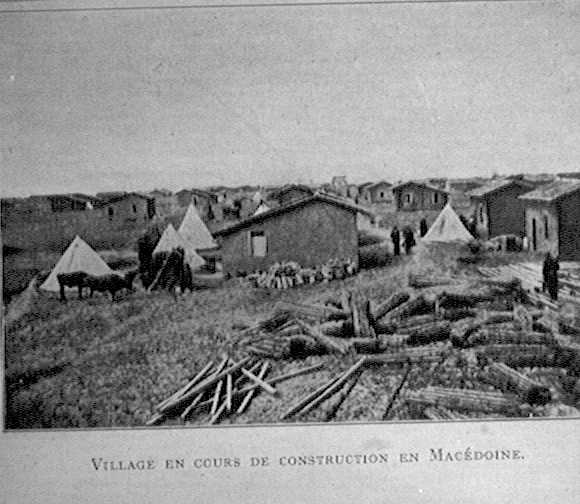
The main problem was that of land and the Greek government was forced to accelerate the breaking up of the large estates (chiftliks) left behind mainly by the Turks who had been exchanged. Only 1/8 of this land was eventually used by the refugees because most of it was given to landless peasants. When that Land and ex royal land was delivered to the RSC, the Commission found out that it was very difficult to distribute this land because there was no cadastre and they first had to survey the land, a fact that delayed the whole process. One of the successes of the RSC was that it managed to settle most of the refugees by 1926 mainly in Macedonia and Thrace.
The Commission provided loans to the refugees and helped them to build their first houses or repaired old ones, it gave them seed for the first year and some agricultural tools and working animals. The Commission was responsible for the use of the 1924 Greek Refugee Loan and for the part of the 1928 Stabilization Loan that was reserved for the Refugees.
|
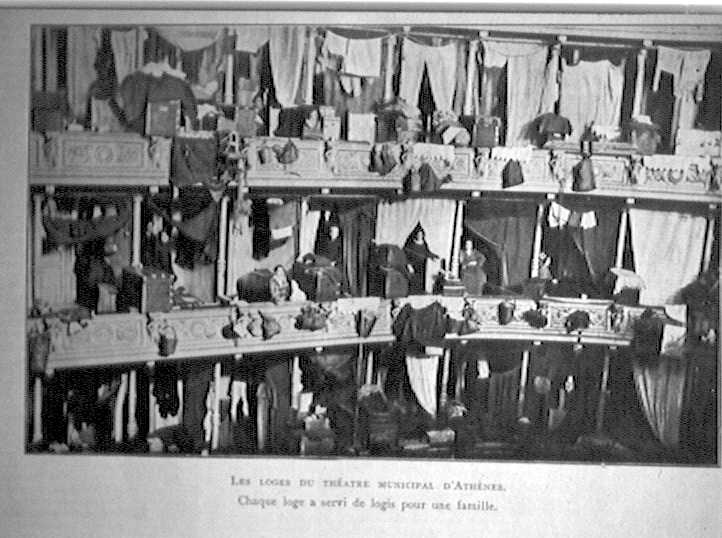
The RSC mainly undertook the settlement of the refugees in the countryside although it helped a lot the refugees who remained in the big cities and especially in the areas of Athens and Piraeus. The Greek government had already set up a Refugee Fund but it ceased operation when the RSC was founded. The Commission built houses in Eleusina, Byron, Nea Ionia, Kaisariani and Kokkinia (now suburban areas of the modern Athens-Piraeus city complex) and tried to help the refugees set up their own export textile and carpet industries, without success though because of the Great Depression that had hit the U.S. and Europe.
 |
The Refugee Settlement Commission was dissolved in 1930 when it had completed its work. Apart from the success of the settlement of such a large number of refugees it faced a number of problems and failures. Some of the refugees who came from rural areas but where not farmers were given land that they did not know how to cultivate. The refugees had to pay for the land or the house they received and a lot found themselves in debt. The Commission had To face the Greek bureaucracy and in some instances was accused of not obeying the Greek laws. Although it was designated as an autonomous organization. Apart from all the problems and the failures though the work of the Refugee Settlement Commission must be characterized as successful.
Henry Morgenthau (1856-1946) was born in Mannheim, Germany, and was brought to the US at the age of nine. He was graduated from Columbia's School of Law. He was ambassador to Turkey, 1913-1916. After World War I he was active in raising money for Near East Relief. In 1923 Morgenthau was chairman of the Greek Refugee Settlement Commision created by the League of Nations. He writing include Ambassador Morgenthaus's Story (1918) and I was Sent to Athens (1929)
... And it was a solid satisfaction next day, on reading their reports of the interview and their editorial comment, to see how every one sounded a note of confidence that was refreshing. The effect on the whole Greek people was instantaneous. They felt that someone with courage, clear vision, and a workable program was now attacking their problem, backed by the good-will of the world as expressed in the League of Nations. Despair was replaced by hope, and lassitude by energy. Offers of cooperation by the foremost Greek officials, industrialists, and leaders poured in upon us at the Commission. We were now sure of the support of public opinion in our work in behalf of the refugees. Indeed, from that day onward we had only to ask either government or private individuals for specific aid in our labors, and it was given with eagerness.
I soon found another dramatic occasion to demonstrate to the Greeks that I was determined to take the boldest measures, where necessary, to render them prompt and effective service. This occasion arose as follows :
Dr. A. Doxiades was the Minister of Public Assistance, and as such had been in charge of the governmental part of the refugee settlement work and had distributed the dole of two drachmas a day. He had ordered a large quantity of lumber from Dalmatia and Rumania; of grain and seed from Russia, Algeria, and Rumania; and of animals from Servia-80,000 oxen, horses, and mules. They were all en route and the government had no funds to pay for them. The cost of all was about 160,000 pounds. The doctor said their predicament was frightful, as it was now November 24th [1922], the cold winter was coming along fast, and the poor refugees would starve unless they could secure these provisions and animals. At the time we had not yet received any money from the Bank og England, which was still questioning Greece as to their spending some of their funds for repairing their navy and buying supplies for their army. We could not possibly tell how much of these provisions and animals would be used for reproductive purposes and on property to be deeded to us or already in our possession. Of course the Greek members of our committee wanted us to help if we could I do so legally. My sympathies were thoroughly aroused, after listening to Doxiades' appeal and recalling the fearful condition of the refugees I had met. So I went in, to see the governor of the Bank of Greece, Mr. Diomede (we were still using some of the bank's rooms as our offices), and I proposed that the bank should share the risk with us. The bank should advance the 160,000 pounds and we would agree to reimburse that part of it which could subsequently be proven to have been used for such purposes as brought it within the restrictions placed upon us by the Protocol.
Diomede surprised me by his prompt and enthusiastic reception of this suggestion. The patriot, not the financier, shone in his eyes as he agreed, without an instant's hesitation, to assume full responsibility for this use of the bank's funds, not waiting to consult with anyone about it.
... Back to Cover